Showing posts with label film. Show all posts

Saturday, October 10, 2015

American Psycho - Analysis

American Psycho (2000), screenplay by Mary Harron & Guinevere Turner, novel by Bret Easton Ellis
OWEN: Call me. (Hands him a business card)
PRICE: How about Friday?
OWEN: No can do. Got a res at eight-thirty at Dorsia. Great sea urchin ceviche.
There is a stunned silence as he walks away and sits in a corner of the room, ostentatiously studying papers.
CLOSE-UP on Bateman’s face, cold with hatred.
PRICE: (Whispering) Jesus. Dorsia? On a Friday night? How’d he swing that?
McDERMOTT: (Whispering) I think he’s lying.
Bateman takes out his wallet and pulls out a card.
PRICE: (Suddenly enthused) What’s that, a gram?
BATEMAN: New card. What do you think?
McDermott lifts it up and examines the lettering carefully.
McDERMOTT: Whoa. Very nice. Take a look.
He hands it to Van Patten.
BATEMAN: Picked them up from the printers yesterday
VAN PATTEN: Good coloring.
BATEMAN: That’s bone. And the lettering is something called Silian Rail.
McDERMOTT: (Envious) Silian Rail?
VAN PATTEN: It is very cool, Bateman. But that’s nothing.
He pulls a card out of his wallet and slaps it on the table.
VAN PATTEN: Look at this.
They all lean forward to inspect it.
PRICE: That’s really nice.
Bateman clenches his fists beneath the table, trying to control his anxiety.
VAN PATTEN: Eggshell with Romalian type. (Turning to Bateman) What do you think?
BATEMAN: (Barely able to breath, his voice a croak) Nice.
PRICE: (Holding the card up to the light) Jesus. This is really super. How’d a nitwit like you get so tasteful?
Bateman stares at his own card and then enviously at McDermott’s.
BATEMAN: (V.O.) I can’t believe that Price prefers McDermott’s card to mine.
PRICE: But wait. You ain’t seen nothin’ yet.
He holds up his own card.
PRICE: Raised lettering, pale nimbus white…
BATEMAN: (Choking with anxiety) Impressive. Very nice. Let’s see Paul Owen’s card.
Price pulls a card from an inside coat pocket and holds it up for their inspection: “PAUL OWEN, PIERCE & PIERCE, MERGERS AND ACQUISITIONS.” Bateman swallows, speechless. The sound in the room dies down and all we hear is a faint heartbeat as Bateman stares at the magnificent card.
BATEMAN: (V.O.) Look at that subtle off-white coloring. The tasteful thickness of it. Oh my God, it even has a watermark…
His hand shaking, Bateman lifts up the card and stares at it until it fills the screen.
He lets it fall. The SOUND RETURNS TO NORMAL.
CARRUTHERS: Is something wrong? Patrick…you’re sweating.
Bateman (Christian Bale) has a hateful rivalry with Paul Owen (Jared Leto), who outplays him at every turn, even though it’s only ever about appearances (He’s not too fond of anyone else who outplays him as well). The rivalry is prevalent among all these guys. But none can touch Owen with his reservation at Dorsia or his unrivaled business card, especially not Bateman who had to lie about a Dorsia reservation, and whose card is second rate to at least a few others.
This is a classic pivotal scene and inciting incident, which reveals Bateman’s deep inner conflict, torment, personal anxiety, and hatred toward Owen, and serves as the premise of the story (Bateman’s psychosis). This incident sets Bateman off on a killing spree, starting later with taking an axe to Owen to Huey Lewis’ ‘Hip to be Square'”.
 

Sunday, September 27, 2015

Happy Endings are Depressing

People sometimes complain about movies with sad or depressed endings. They want upbeat, feel good, inspiring. They want the fairy tales. But do happy endings actually make you happy? Do down endings make you sad? I don't think so.

When you've seen a a movie with a happy ending and then have to face reality, you inevitably come to the realization that you don't have a happy ending. You don't have any kind of ending. Even when you die, you won't experience the ending of your life, because it will be over before you can experience it.

When you've seen a movie with a sad ending, you may think about how the characters went wrong. You may think about how lucky you are not to have experienced something so depressing. Even if you had experienced it, you can feel consolation with characters that share your experience.  The outcome of a sad ending is to make you feel better.

When I got out of college times were tough, as they probably are for most kids just out of college. I could barely find enough work to survive. It was depressing as hell. So what did I do to feel better? No. I didn't go watch movies with happy endings. I couldn't afford movies with any kind of ending. I simply went out for walks in the city. And what did I see? Homeless people of course. People living depressing lives, too poor to have a car, taking buses. Waiting at bus stops like zombies. I would walk down the street and see all the lonely people, just like the Beatles song. Then I'd feel better. I'd feel sorry for them. But I'd feel better about myself, because even though I didn't have much, I had enough to feel like I had more than a lot of other people had.

You might have expected me to say that I least I had friends. But I didn't really. They'd all left college. They weren't around. My parents were staunch conservatives. They didn't want me around the house. So I can't say I had family either. I had nothing but myself. But I was comfortable with that. I had my films that I was working on. I had ideas. There was always the future. If there's a future there's hope. You have the opportunity to continue to live and make something happen.

Happy endings will depress you. But sad endings give you hope in what you have. Now try explaining that to the genius Hollywood MBA studio heads.

Sunday, September 20, 2015

Leaving Las Vegas: Analysis

Leaving Las Vegas (1995)
John O’Brien (novel)
Mike Figgis (screenplay and director)
with Nicolas Cage and Elizabeth Shue

Scene

INT. RESTAURANT – NIGHT
Ben and Sera are eating. He plays with his food, eating very little of it. Finally he pushes it away and orders another drink.

SERA: I’m from the East. I went to college, did an arts course. I now live in Vegas. I think of it as home. I came here deliberately to carve out a life. I was in LA before, but I’ll come back to that later. (pause) The tough times are behind me now. I can deal with the bad things that happen. There will always be dark characters. But my life is good. It is as I would want it to be. So, why are you a drunk?

BEN: Is that really what you want to ask me?

SERA: Yes.

BEN: (worried) Well, then I guess this is our first date… or our last. Until now, I wasn’t sure it was either.

SERA: Very clever.

Sera thinks for a while and decides to give in to him on this.

SERA: First. It’s our first. I’m just concerned. So… why are you killing yourself?

BEN: Interesting choice of words. I don’t remember. I just know that I want to.

SERA: Want to kill yourself? Are you saying that you’re drinking as a way to kill yourself?

And she leans across the table to be close to him, listening intently. Ben becomes uncomfortable and tries to joke it off.

BEN: Or killing myself as a way to drink.

Sera continues to stare at him, wanting to know the real answer. He takes a slug from his drink. She sits back.

BEN: We’ll talk about it some other time maybe. OK?

Sera relaxes and continues with her food. We hear her thoughts for a moment.

SERA (v.o): It wasn’t so important to me. I mean, he never asked me why I was a hooker, and that was impressive. I really liked him. So I decided to just play my part. I mean… it’s good to help someone once in a while., it’s a bonus to being alive, and that was my plan… to stay alive. I suddenly came to a decision.


Analysis

I love this movie. Cage got an Oscar. Shue was nominated, along with Figgis for screenplay and direction. It’s a classic great with a wonderful bluesy jazz track. It’s one of those rare films where everything comes together.

This scene sticks in my mind, especially the line about how killing himself is a way to drink. That line is very representative of his character. He is always jovial and light about everything, with a few exceptions of rage. But this indicates how he rationalizes and accepts his depression. He’s OK with killing himself. And it seems he doesn’t even know he’s depressed. Or doesn’t admit it. That way he can carry on life as if it’s all very acceptable.

In fact numerous great writers seem to fall into depression and even suicide. And the novel is semi-autobiographical. In writing, if you put your soul into it, it can be reflective and can bring up certain thoughts such as the general futility of life (everything ends). In Hollywood this kind of demise seems even more a rule than an exception. Success is usually short lived. It’s wonderful to face these things through this character.

Sunday, December 21, 2014

Moneyball, Written by Steven Zaillian and Aaron Sorkin

The Scott Hatteberg walk off scene.
This is a very typical sports underdog makes good scene, with a winning move at the climax of the movie. What’s interesting with Moneyball is that it’s main premise is that very thing, how overlooked underdogs actually have talent that can make all the difference. There is very little dialogue. Though we see the coach have to coax Hatte out to bat. Hatte isn’t expecting this at all. The build up is great. And in fact, it’s this sudden lack of dialog that makes us pay attention and gives the feeling of suspense and anticipation. Note that in the locker room Billy watches a MUTED TV, adding lack of sound to the lack of dialogue. There is something to be said for silence.

EXT. OAKLAND COLISEUM FIELD – NIGHT – BOTTOM OF THE 9TH 152

The scoreboard shows us that it’s still tied in the bottom of the ninth. Nobody’s out. DYE grabs a bat and walks to the plate. Then, inexplicably, Howe turns to-

ART
Hattie. Grab a bat.

SCOTT HATTEBERG actually points to himself and mouths, Me?

ART
Let’s go.

SCOTT pulls a bat from the rack and heads to the on-deck circle. He only manages a warmup pitch or two before –

INT. WEIGHT ROOM
Billy is watching on a muted television as he sees Dye fly out to right field. As Hatte approaches the plate, he kills the TV.

EXT. OAKLAND COLISEUM – SAME TIME
As ROY STEELE’s booming voice echoes:

VOICE OF GOD
Pinch hitting for Eric Byrnes–Scott
Hatteberg.

Scott’s wife, ELIZABETH, watches from the VIP seats. She clutches her face. SCOTT lets the first pitch go by.

UMPIRE
Ball!

Art Howe looks like he can’t stand it any longer. In the dugout, Koch looks like a psychopath ready to kill.
SCOTT steps out of the box to catch his breath. He steps back in and stares at the exact spot in space he thinks the pitch will leave the pitcher’s hand.

The pitch. SCOTT swings.

Crack! 55,000 erupt. The A’s leap to the front of the dugout steps and watch.

We see the ball ascending on a strong trajectory, but before we can know for sure where it’s headed, TIME SLOWS TO A CRAWL-

INT. WEIGHT ROOM – SAME TIME 155

BILLY’s sitting on the floor with his back against the wall, trying to breathe. He looks like he’s in pain. He can’t move.

He hears the crowd ERUPT outside. His Blackberry buzzes: “hatte homered. a’s 12, ryls 11″
Billy flips on the TV. With sound off, he watches silent images of his team swarming the mound in (archival footage) mixed in with Art Howe celebrating with them.

EXT. OAKLAND COLISEUM – SAME TIME

The place is going crazy. ELIZABETH is screaming as she watches her husband get mauled by his teammates at the plate.

Saturday, June 7, 2014

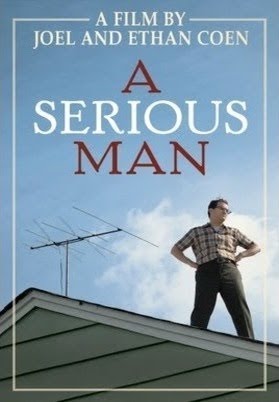
Review: A Serious Man

Originally posted on the Black List

Title: A Serious Man [download a PDF version of the script here].
Year: 2009
Writing Credits: Joel Coen & Ethan Coen
IMDB rating: 7

IMDB plot summary:
Bloomington, Minnesota, 1967: Jewish physics lecturer Larry Gopnik is a serious and a very put-upon man. His daughter is stealing from him to save up for a nose job, his pot-head son, who gets stoned at his own bar-mitzvah, only wants him round to fix the TV aerial and his useless brother Arthur is an unwelcome house guest. But both Arthur and Larry get turfed out into a motel when Larry’s wife Judy, who wants a divorce, moves her lover, Sy, into the house and even after Sy’s death in a car crash they are still there. With lawyers’ bills mounting for his divorce, Arthur’s criminal court appearances and a land feud with a neighbor Larry is tempted to take the bribe offered by a student to give him an illegal exam pass mark. And the rabbis he visits for advice only dole out platitudes. Still God moves in mysterious – and not always pleasant – ways, as Larry and his family will find out.
Tagline: …seriously!

Awards:
Nominated for Oscars for Best Original Screenplay and Best Picture;
Nominated for Golden Globe for Best Actor, Michael Stuhlbarg
Nominated BAFTA Best Screenplay
Won AFI Movie of the Year
Nominated Eddie Best Edited Feature
Nominated Art Directors Guild Excellence in Production Design Award
Won Independent Spirit Award Best Cinematography Roger Deakins
Won Robert Altman Award
Nominated Independent Spirit Award Best Director Ethan & Joel Coen
Nominated WGA Best Original Screenplay
Numerous others

Analysis: What stood out to me immediately was the detailed camera directions in the script, and very much a big part of telling the story. Of course the Coens are director-writer-editors. It makes sense that they might see the film at the script stage in terms of how they intend to direct and cut it. The film is 107 minutes. But the script is 133 pages, which testifies to the added camera direction, despite a page or two of cuts at most. I looked at two other Coen scripts and saw a similar treatment at the beginning of Fargo and Raising Arizona. But A Serious Man is a bit more so. I think there is a tendency among novice filmmakers to write this way until they are corrected to leave that detail to the director, even if it’s themselves. But this is not generally recommended. They also ignore conventions like INT. or EXT. in the scene heading. Instead they just put the location there. They do not place the character name line when the same character speaks with action lines between. It makes for easier reading.

I watched the film after reading the script. Though I had seen it before. But I didn’t notice much difference from the script, except stuff that was cut. It’s impressive that the script is pretty much exactly what the film is. The theory on making movies is that there are three versions, the script, the one you direct and produce, and the one you edit. Not so with the Coens. What they write is what the final product is.

It’s been said that film has a long way to go, that the best films are yet to be made. I like to compare film to music, which has been around since the classics, about 400 years. I like to think that film could be more like a classical composition with the various instruments, melody, bass, rhythm and so on, analogous to image, sound, dialog, effects and so on. Could film be done more harmoniously as music is? The Coens seem to approach this concept, especially considering their script as the composition, is strictly adhered to as a musical composition is. The idea that the writer(s) control everything from image, to effects, to music. to dialog, in the script, the direction and the editing; makes this kind of harmony more likely than relegating these things to separate people, or at separate stages.

The theme of A Serious Man is quirky and magical for me; about the futility of being concerned over things in your life you cannot control. The setting is a period 60s Jewish community. The characters are both religious and irreverent, and perhaps naturally hypocritical. They are all either shallow or self centered. This reflects on the protagonist as someone who isn’t really close to anyone, considering everyone is seen through his perspective. The film even seems to say that irreverence is a part of life and a part of Judaism, at least among lay people. In this way it pokes fun at being serious or at taking religion literally. And this is the dilemma of the protagonist who wants desperately to understand things in his life that affect him and that he can’t control, and who looks to his religion for answers.

The protagonist goes through nearly all of the film with no real arc or change. He is simply put upon by his family and people around him. He mostly accepts his fate and everything his wife tells him to do. He is pushed around. Yet at one point he decides to take a stand. But this has absolutely no effect, which makes him even more frustrated. He looks to Rabbis as mentors. Externally they appear more as tricksters who tell him there is no answer. Yet internally they are telling him not to be concerned over such things. By the end he does arc ever so subtly. He accepts that he cannot understand these things and must move on.

The film is very unusual and original in having a passive protagonist and no real dramatic overcoming of an obstacle. It’s all very subtle and even easy to completely miss. I think this is why the film is misunderstood, underrated and even considered a failure by people who are used to being lead by the hand through a more conventional traditionally structured story, with a strong arc or strong climax. On the other hand, if you can accept the originality, it’s a film that makes you really think.

In this clip the protagonist sees the junior Rabbi, who talks about the inner world or the expression of Hashem (translated as the Name or God) in the world, as opposed to seeing Hashem as externally living only in shul (the synagogue). I see this as a parallel to inner world and outer world of the protagonist, and his inability to reconcile them. By the way, this script sent me to the dictionary. Though the word meanings are apparent in context.

The Jefferson Airplane song ‘Somebody to Love’ is used as a device in the film and echoes the theme with the line ‘When the truth is found to be lies, and all the hope with in you dies…’ You could even say the entire film concept stems from that line. It’s a simple genius. Another rule the Coens break is to explicitly use known songs in the script.

Most Memorable Moments: The second Rabbi tells Larry the story of a man with inscriptions in his teeth, that turn out to be meaningless. Larry doesn’t understand the point of why he was told the story. And the Rabbi basically responds that here is no point. That’s the point. It is wonderfully comedic. This also echoes encounters with others characters.
Larry: So what did you tell him?
The rabbi seems surprised by the question.
Rabbi Nachtner: Sussman?
Larry: Yes!
Rabbi Nachtner: Is it. . . relevant?
Larry: Well—isn’t that why you’re telling me?
Rabbi Nachtner: Mm. Okay. Nachtner says, look. . .
The consultation scene again, with the rabbi once again narrating in voice-over. He silently advises the fretful Sussman in sync with his recounting of the same.
. . .
Rabbi Nachtner: The teeth, we don’t know. A sign from hashem, don’t know. Helping others, couldn’t hurt.
Back to the rabbi’s office in present. Larry struggles to make sense of the story.
Larry: But—was it for him, for Sussman? Or—
Rabbi Nachtner: We can’t know everything.
Larry: It sounds like you don’t know anything! Why even tell me the story?
Rabbi Nachtner: (amused) First I should tell you, then I shouldn’t.
Larry, exasperated, changes tack:
Larry: What happened to Sussman?
Sussman, back in his office, works on different patients as the rabbi resumes the narrative in voice-over.
Rabbi Nachtner: What would happen? Not much. He went back to work. For a while he checked every patient’s teeth for new messages; didn’t see any; in time, he found he’d stopped checking. He returned to life.
Sussman, at home, chats with his wife over dinner.
Rabbi Nachtner:. . . These questions that are bothering you, Larry—maybe they’re like a Toothache. We feel them for a while, Then they go away.
Sussman lies in bed sleeping, smiling, an arm thrown across his wife.
Back in the rabbi’s office, Larry is dissatisfied.
Larry: I don’t want it to just go away! I want an answer!
Rabbi Nachtner: The answer! Sure! We all want the answer! But Hashem doesn’t owe us the answer, Larry. Hashem doesn’t owe us anything. The obligation runs the other way.
Larry: Why does he make us feel the questions if he’s not going to give us any answers?
Rabbi Nachtner smiles at Larry.
Rabbi Nachtner: He hasn’t told me.
Larry rubs his face, frustrated.
 Most Memorable Dialogue: The last and elder Rabbi, Marshak, at the end talks to the Bar mitzvah boy, Danny, and returns the transistor radio confiscated from him by his teacher.
Finally:
Marshak: When the truth is found. To be lies.
He pauses. He clears his throat.
At length:
Marshak:. . . And all the hope. Within you dies.
Another beat. Danny waits. Marshak stares.
He smacks his lips again. He thinks.
Marshak:. . . Then what?
Danny doesn’t answer. It is unclear whether answer is expected.
Marshak clears his throat with a loud and thorough hawking.
The hawking abates. Marshak sniffs.
Marshak:. . . Grace Slick. Marty Balin. Paul Kanta. Jorma. . . somethin. These are the membas of the Airplane.
He nods a couple of times.
Marshak:. . . Interesting.
He reaches up and slowly opens his desk drawer. He withdraws something. He lays it on the bare desk and pushes it across.
Marshak:. . . Here.
It is Danny’s radio.
Marshak:. . . Be a good boy.
What Did I Learn About Screenwriting From Reading This Script: I learned that camera direction can be very useful and can help to visualize the story cinematically. One criticism I’ve heard about some screenplays is that they aren’t cinematic enough. I think screenwriters have to be conscious of this, and able to picture the script on the screen. Reading this script is like watching a film.

I learned that there is something very beautiful in simplicity. Something like a phrase from a song you love, or even the basic theme of a bible story (like the story of Job), can inspire a cool movie.
I learned that ambiguity and subtlety can make the audience think and make a film much more interactive that way. Those are the kinds of films I tend to like the most. The idea that some people can get something out of it, while others may not, gives the film a controversial reaction and starts a conversation.

Finally, don’t be afraid to break rules and conventions. You just might invent something very original.

Thursday, March 6, 2014

The Making of a Political Documentary

Directors Statement: got healthcare?

Background

In 2008, thinking people were very tired of George W. Bush, and especially the wars that waged on endlessly. There was a lot of political issues debate between McCain and Obama supporters during the presidential campaigns. I had done some pro-Obama political blogging with the Huffiington Post. I bought his hype and lies. In September with the market crash and subsequent bailouts, McCain as a Republican, became the underdog in the presidential race. This was all a function of what happened on Wall Street. In a way, it was Wall Street that elected Obama, including through direct financial contributions. Earlier, in March of 2008, there were some big anti-war protests marking the anniversary of the war and occupation of Iraq. I decided to do an anti-war documentary. I filmed local protests. I did research and built a website. I read The Three Trillion Dollar War (2008, Nobel Prize winner Joseph E. Stiglitz and Harvard professor Linda J. Bilmes). I found RSS feeds to veterans anti-war groups, like the IVAW (Iraq Veterans Against the War), and the West Point Graduates Against the War. Then this activism was subverted by health care reform.


After Obama's election, activism quelled. Had McCain won, more activists would have been galvanized to greater action. The pressure on Congress would have been overwhelming and we might have seen an end to the wars. Although it would have taken another cycle to get a receptive regime into the White House. As it is, Obama persisted Bush's programs and policies, and escalated war, with little pressure from the public to do otherwise.

The war protests were subverted by Congressional interests in health care reform. Senator Max Baucus (D - Montana) held hearings (excluding 'single payer/medicare for all' advocates), and then hired Liz Fowler (former Wellpoint Insurance PR exec) to write a bill. This launched street protests by activists around the country. These were activists often subverted from war protests. Obama successfully got the attention away from the wars and onto health care reform. But the media had virtually no coverage of the street protests nor the ones inside the Baucus hearings. Since I was on activist email lists, I got wind of these protests and decided to go out to film the coverage the media ignored.

Protests

I was surprised and even amazed to find very intelligent activists including doctors and nurses out in the streets at these protests. I asked them what their concerns were, as much for myself as for a potential film. I interviewed over 65 people. I got answers to what it was all about. There were alarming statistics. 45,000 Americans died annually due to lack of health care. 48 million Americans had no health care insurance. Most people with insurance were denied coverage. The insurance industry overhead costs 30% of the money spent on health care compared to 4% in other countries. America ranks 37th among all countries for health care performance and 51st in fairness. 61% of bankruptcies and foreclosures are due to health care debt. Over half of all doctors are in favor of a single payer system. All these statistics remain true or are worse in 2014. The opposition to these protests were conservative organizations or paid protesters known as Astro Turf (fake grass roots). I filmed them as well and got their sides of the story. They said the health care industry needed more competition, and that we had a problem with tort. They said they didn't want the government making health care decisions for us. One woman didn't want "those people" in her hospital. Another said health care would be diluted and that we have to pay for care, that there is no free lunch.

I used this to go back and forth between one side and the other to get responses to the opposition. The activists laughed at the competition argument, saying that what we already have and that's what's caused the problem. They said tort amounts to only one percent of costs compared to the 30% insurance companies spend on administration and advertizing. They said we pay taxes and deserve care and that health care is a right and should be handled by government, just like fire and police protections to life. They said lobbyists spent millions daily to buy Congress. Senator Baucus received hundreds of millions from health care industries. In this way I constructed a stream of conversation film with one side making a point and the other side making a counter point.


Going it Alone

Maureen Cruise RN
I filmed these protests with no screenplay, no written plan, and no crew. It was just me with a camera and mikes. I edited it myself using the material to define the structure. One of the nurses, Maureen Cruise, was extremely knowledgeable and spoke so eloquently that I considered her as a sort of narrator. I used pieces of her 28 minute interview throughout the film. Later on, after I had a cut ready, she offered to distribute DVDs. So I credited her as an executive producer, whether she wanted to be one or not. Another great thing was that activist organizations like MoveOn, and health care reform groups, staged protests, rallies, and sit-in, complete with arrests and other entertainment. this all help ed to make for some dramatic footage along with the very passionate activists. It was all there for me to simply show up and point my camera at. Many of the doctors and nurses were and are members of PNHP (Physicians for a National Health Program), the Mad as Hell Doctors, HCA (Healthcare for All) and what is now the LA Healthcare Coalition. The issues persist along with the activists.

Editing and Distribution

I had a cut ready at the end of 2009. It was two hours. I got some feedback that it had to be cut to at least 90 minutes. I did that about five more times with improvements in each version. Maureen became involved in 2011. She even attended the AFM with me. She found AFM somewhat disgusting with all the posters for blood and gore horrors and thrillers. She later wrote that she thought Hollywood would never give issues like this a forum. But the experience gave her an education and helped me a lot. I got a good handle on what it takes to market and distribute a film. I did connect with sales agents interested in the film. But they were relatively unknown and didn't have any kind of track record I could have any faith in. You have to research these companies. They also wanted all-rights deals for outrageous time ranges (up to 20 years) and percentages (up to 40%). I could have negotiated better deals. But I had no faith in any of them and turned them down.

The latest major cut was in March 2013. I added footage of the Baucus hearings protests and coverage of the ACA (Obamacare) passage and reaction from 2010. I was able to sell a few hundred dollars worth of DVDs on my website and through Amazon. A few activist organizations have had screenings. Lately I've had renewed interest in the film.

More about got healthcare? (a political documentary) here.


Saturday, February 1, 2014

There is no Roger Corman

Money: The Root of the Problem

We tend to think of making art as picking up a tool and just doing it, which is an ideal. That can work in painting or writing. But film is a whole different thing. or is it? You can pick up a camera and start shooting. The problem there is that the complexity of film will bring you to a point where you find out you aren't prepared. Perhaps you get into editing and find the lighting isn't working or an actor doesn't fit. So the next time you take more care with casting and getting a good DP and a good grip. That's basically the process of leaning to make films.

David Lynch
However, even highly experienced and seasoned directors and producers complain about the distribution end of things. They can't earn enough money with their films to move on to the next one. Directors like Lynch, Spielberg, Soderberg or Coppola have made statements to this effect. If they can't do it, what are your chances? We're missing an element from the start that we can never get right, and that is knowing what is required to make the film sell.

Roger Corman
It's too bad we just can't all collaborate with professional courtesy on each others films instead of paying each others rates. That's what we did in film school. Some of us carry that over into the business world. In the heyday of Coppola coming out of UCLA joined by Lucas and film school colleagues at USC, those guys had it down. Although Roger Corman was around to give them salaries. Since then a lot of film school grads try to emulate that model. But like a bad marriage, you find out your former classmates aren't right for you. And then there's the fact that we can't really get by in this world without money. To fund a film before you pick up that paint brush, you need a lot of money.

Even huge studios with business and marketing expertise cannot be assured of seeing a film production break even. But we all know all this. We know that no one knows anything. And so we make wine on the side or cut an ear off or die penniless.

The Solution

What we need to do is get the money worked out before we pick up the paint brush. That means we have to make art that will sell. The key to this is the word "art" not the word "sell." The art has to have a mass appeal. We will sell it for only a $2 to $8 rental or maybe a $5 to $25 purchase. We have to sell a huge volume to make out. We can't just make a movie that appeals to ourselves or even a circle of 10,000 like minded people. We need to appeal to half a million or more.

Alternatively we could sell at higher prices. Assuming an audience of 10,000 people will buy our film, we need to sell copies at $100 each to cover a $1 million budget. $50 for a $500K budget and so on. At $5 each we can cover a $50K budget. But only if 10,000 spend $5 each to see our film. And at that budget we get paid nothing. What does it cost a cast and crew to live? Maybe $20K each at the poverty level. You get it.

Obviously we need that half a million people to want to buy our movie. Though government subsidies or grants could work too, except there are 500,000 filmmakers in the world. We'd have to end war to do that.

The number one reason why you can't make a living at this in this world is because you don't make movies that attract a half million people. But that's just the tip of the iceberg, because attracting them is a whole science in itself, which is why we need distributors to market films.

Distribution and Marketing

Sex sells: Marketing image of Sharon Stone in
Joe Eszterhas' Basic Instinct
You may not need to know how to attract a half million people if you can figure out how to attract the right distributors and investors. But they will think they know how to attract the half million and they will look for elements in your film that do that. There are a lot of distributors and investors with varying ideas on what will sell. There are a lot who will sign a deal and you'll never see a penny. You need a film that will make them agree to your terms that give you enough money to cover your costs, and in advance of going into production.

You can go with conventional wisdom with the right marketable script, probably about a contract killer, or a serial rapist, and with a name cast. Or maybe you could prove that people want to see your film by signing them up with your own marketing campaign, like crowdfunding or social networks. If you have an email list of half a million people who are engaged in your project, and if you can prove that to a distributor, you can probably sign the right deal to get your film funded. 

The sellout

Does that mean you have to compromise your art? Maybe. But isn't it more of an artistic challenge to attract an audience? Wouldn't that prove to people and yourself that you are talented on many levels? Isn't that the key to sustaining a career as a film artist?

All those other technical details about how to go about producing, funding, distribution deals, budgeting, collaboration and so on, are important. But the audience is the top priority. Even without distributors you can sell directly if you have an audience. You need to be in a place where distributors need your film more than you need them. If you're not there you have to keep making films to learn how to get there. Try and try again. It's not the seventies. You aren't Coppola. There is no Roger Corman.

Indie movies that sell have these elements. Scorsese,  Coppola. Lynch and the Coens make indie films that sell along with some that don't. They are in a place where I'd want to be as an indie filmmaker.  

But there's always yet another Sundance movie made for a fortune that no one will buy and no one wants to see except the guys that made it and their small following. Those indie films make money for festivals, equipment manufacturers, and even the cast and crew. $3 billion is spent annually on by filmmakers who rarely ever make a sustainable career of it.  The trick is to make movies that make the filmmaker a living, not everyone else.

NOT ANOTHER SUNDANCE MOVIE
A Tastes Funny Original Trailer
Written by: Molly Fite, Susan Mandel, John Ott, Autumn Proemm & Chris Punsalan
Directed by: Chris Punsalan
Photographed by: Chris Punsalan & Stephen Mader
tastesfunny.net
Starring: Molly Fite, Dan Banas, Todd McClintock, Samantha McLoughlin & Lucy McLoughlin.

Thursday, January 16, 2014

You're Killing Me

Ted Hope posted about the poor state of indie film distribution, his frustration with deals that pay out so little that screw indie producers, and how he's decided to stop producing. This marks a turning point. I had to respond with this comment:
The main reason indie films have distribution problems has to do with compulsive behavior to take whatever deal you can get. [Distributor-Sales Agent] Lists are good, if they are vetted. There are a lot of unscrupulous players out there. And even with good distributors and sales agents, you have to hold out for the terms you want.
If indie filmmakers keep signing all rights deals, then that becomes the norm. If we give distributors 20% off the gross, or add P&A expenses first, then that becomes the norm. These things kill independent film.
I'm pretty sure that in any other industry, the manufacturer is paid a wholesale price for product. If it's not all sold there may be some return. But you don't see retail outlets deducting advertising costs from sales or taking 20% off the remainder sales gross before the manufacturer sees a dime. No manufacturer would agree to those terms. Why do we?
I'm pissed that the guy who produced 21 Grams doesn't want to produce more films, and because I
think it's the fault of most indie filmmakers who take bad deals. 

Every time a producer signs an all rights deal without a six month performance agreement, or with a back-end 20/80 split after unaccountable P&A (publicity and adverting). they are hurting all of our chances to make a sustainable living with film. Maybe filmmakers need more education.

It's just my opinion (see others here), but filmmakers should always retain rights. For example, sign limited rights for a limited period of time, such as six months for foreign territories (performance agreement), while retaining the right to separate domestic distribution, and direct website and digital. If a distributor can't get you a deal in six months you need to move on to someone else or do it yourself. Films age fast. Some are even more timely than others.

You need foresight when you write a screenplay or start a production. I started filming health care reform protests in 2009. I didn't know anything about health care reform. All I knew was that a lot of people were gathering in the streets to complain about it. And it was completely ignored by the news media.  If there's one thing I hate it's the news media ignoring people.  I will not be ignored.

Out there I learned through interviews what it was all about. My questions were as much for me as for my audience. I was amazed to find doctors and nurses out in the streets in these protests. They were (and are) besides themselves helplessly watching people suffer and die, for lack of health care, at the hands of insurance companies who make insurance unaffordable, or even deny claims when people do have insurance. The statistics are outrageous. 48,000 Americans die every year for lack of health care. This happens in no other industrialized country where health care is considered a human necessity, like food, water, police, fire protection, or the golden military. America ranks 37th in healthcare performance and 51st in healthcare fairness among other countries of the world. Cuba has a more fair system than America does. So this got me passionate enough to see through the making of a feature documentary over the next four years.

But the film was not marketable (as Maureen Cruise, my exec producer, notes here). You could assume that distributors did not want to promote a film counter to the healthcare industries (insurance, pharmaceuticals, cancer, hospitals, medical devices) that comprise one-sixth of the American economy (with a 30% overhead), despite the fact that 16 times the number of Americans killed in 9/11 are effectively killed by these industry lobbies every year. So when I was offered an all rights deal at a 40/60 back end split, if I would change the title of my film, my answer was no deal. They offered better terms. But I didn't like the company, nor three others as well. Never heard of them. No deal is better than a bad deal. Post that to your wall. So I decided I would stick to self distribution on my website and Amazon. Maybe I'll go up on Vimeo.

The point I'm making is that you can't take the first deal that comes along, nor the second, third, fourth, nor any, if they aren't good deals. However, most first time filmmakers jump at bad deals. It is almost unheard of to pay an indie filmmaker upfront for their hard work (especially without stars). In the indie world there are rare cases of the MG (minimum guarantee), which means a distributor will agree to pay a minimum amount of maybe $20K for example (usually a paltry sum like that), for the acquisition of your film. There are also rare cases of pre-sales, which means the distributor finds foreign territories that agree to pay a certain amount (usually totaling between 20% and the more unlikely 70% of your budget) for the acquisition of your film. I wouldn't mind some pre-sales and MGs if I could get them. Add 30% pre-sales to 30% in tax credits and you have funded 60% of your budget before the start of production. With that, you can likely easily find investors to back the rest of your budget. But you'll have to finance that 60%, because you don't get it all back until well after the film is finished. If your budget is under two to five million, you likely have to have private investors do that financing for you. A bank or bond company will not be interested otherwise. Regardless, you have to add around 10%-20% of the financed amount to your budget for interest, plus maybe 2% for a bond. That's the way to get a film financed. Also with pre-sales and a signed on distributor, assuming they are credible, you have built in distribution to your project before you even start. Then after production you move on to the next project instead of spending a year or two to find distribution deals or to self distribute. Nice work if you can get it.


If you can't get pre-sales or MGs, then you are left with the tax incentives (up to 30%) and the rest has to be from private investors. On a low budget film, that's doable. But without the MGs or pre-sales, you don't have skin in the game from any distributor. So I think it becomes more likely you'll see bad deal offers, which you should refuse, or revise the terms of. Of course, your investors may pressure you to take them, because of the false perception that having any distributor is lucrative. There are all kinds of distributors and all kinds of deals. Odds are you'll see nothing at all from them. It's likely you can do better to self distribute, especially with the advancement of internet digital distribution.

Self distribution can include self-theatrical (as with Tugg), and digital platforms like Fandor and Vimeo. There are others that you really need to have an aggregator for, like YouTube, Distrfy, Hulu, Roku, iTunes (which I think includes Vudu), and others. An aggregator is a digital distributor that does not deal with theatrical or other things that traditional distributors do, such as P&A.  Indie Rights is an aggregator (and production company) that will give you some great information even if you don't sign with them. They'll tell you where you can easily distribute on your own as opposed to where you need an aggregator. Distributors have to market your film, which is why they want a take, right off the top, to recoup their expenses. So you have to decide if their services are really worth you and your investors making nothing for you effort. But a lot of indie filmmakers and their investors are star-struck and will sign any deal they can get. Without MGs, pre-sales, or contracts that stipulate VOD, cable, TV or theatrical, distributors can take you for a ride. They can go to the aggregators and keep 20% plus the 20% they pay the aggregator as an expense, plus their possibly non-existent unaccountable P&A, leaving you with nothing. If you go direct to an aggregator, they take a straight 20%. But I would want to have some transparency in their accounting as well.

All these numbers vary by film and with time. Things change. A film with names may be more marketable and draw more interest. Splits and interest charges change. You have to talk to a working sales agent or aggregator that has the pulse of the industry to find out what your film can do, and you should do that before shooting one frame, and before booking one actor.  [More on this process information on Stacey Parks's FilmSpecific and Adam Cultraro's Million Dollar Blueprint]

When most filmmakers take bad deals from distributors they make it bad for all of us. It is now the norm to get an initial offer from a distributor for a 40/60 split after P&A or even nothing. In other words, it is now standard practice in the industry to take indie films from filmmakers for nothing in return.  The reason this happens is because indie filmmakers agree to these deals. We give away our films for free. Our $3 billion indie film industry makes a 2% profit because of our bad star-struck habits. Two years after you make that deal, you're frustrated with the business, bitching about festivals and how you can't get a deal, or if you get a deal, how you can't make any money, and so you quit and become an accountant or you make reality shows or you make wine. You're killing yourselves. You're killing the industry. You're killing me.

You may say, well that's the way the business is. If I don't take that bad deal, I won't get any deal. Good. No deal is better than a bad deal (Peter Broderick).  If no one takes bad deals, bad deals will cease to exist. If you keep taking bad deals then don't whine and moan about how bad the industry is, or how it's a boys club, or how the studios screw you over. They screw you because you agree to let them. Think before you sign. Research. Vett. Get an attorney. Where will you be in two years? Will you pay back your investors. Will you be able to say you made a profitable film? Will you be able to find funding for the next one? Will you spend two years at film markets selling instead of making movies?

Capitalism works by supply and demand. Wait for a good deal. Starve the supply. Create demand. The market can't sell films without films to sell. We see the markets manipulated. But as a filmmaker, you are part of it. You can agree or not agree to deals. The market is what we collectively make it. Every time a filmmaker makes a bad deal it hurts us all. It is better to make your film on the cheap with no intention of distribution or sales. If you need investors tell them, this will not be distributed. No money will result. At least then you are free to make your movie and it will add to your experience and repertoire. It will gain you some respect, colleagues, and contacts. It will be the making of a movie and not the selling of stuff at the market. What am I missing?

Wednesday, January 15, 2014

Why and How to get a Distribution Deal?

Film Production and Distribution
in one Indie Company
You're an indie filmmaker. You can get by with relatively inexpensive equipment, cast and crew and make movies. I made a short a few years ago for $3K, just for camera, sound, and editing software. Then I used the same stuff to do another one for the cost of feeding the cast and crew, about $500. A few years later I made a feature doc for $3K with some new HD stuff. But you don't need a cast or crew for docs. All you need is a camera, editing software, and great events to attend. However, if you do want a cast and crew, and you don't happen to know film school buddies willing to work for free, you really have to pay them, and you may need locations, props, and so on. So we see budgets more likely starting at $50K to $500K for first time feature director narratives.

If you want your film to be attractive to sales agents and distributors you will likely need some name talent. That will cost you anywhere from $5K to $50K at a minimum for a week of their time, depending on how hard up they are for work. But lately the trend is away from names and towards just really compelling stories. The script has become all important as it should be. With a great script you probably can attract some names anyway, which would add marketing value. Actors will want a killer script before they're willing to work cheaply or for a back end.

This is known as the chicken and egg dance thing that filmmakers do with talent and distributors. If you have a script good enough to attract talent, they (their agents actually) may be interested, but they will likely want to first know that your project is funded. If you had the talent signed on first, you could more easily find investors, or even pre-sales to fund the project, just based on the talent. So you have to be creative. Tell the talent that yes you're funded, which you will be if they are interested after reading the script (but don't tell them all that), assuming your distributor and investors concur. And yet it's not that quite easy.

There are requirements and priorities you have to have in place before talking to talent or distributors.
  • The script has to be compelling. 
  • You have to have a vetted project. You need a professionally done budget and shooting schedule by an experienced UPM (around $2K to $5K). 
  • You need to have a crew lined up (to be paid upon funding). And that crew or production company should have a track record. 
  • You also need to register a company (from $400 and up annually), 
  • and hire an attorney (around $5K) to review contracts and give your project credibility 
  • You need some completed work, short films, or maybe a proof of concept short film or trailer
Whoever looks at your project will want to know that you can actually pull it off (Why should they invest thousands of dollars?). With those things in place you can go to a state film commission to get approved for tax credits, up to 30% or so of your budget. State approval says your project is real to investors and distributors, and you can claim that as a funded part of the budget. Maybe you can get grants or government subsidies, especially outside the US. But the question may remain, is it marketable?

Part of the dance thing is to check with sales agents what talent you have in mind and how marketable they are for your project. If you don't have names, you should have a skilled cast. And this is where things fall apart for me. Because I think that named talent are in demand because of their talent. It's unlikely a cast without names can pull it off as well. But not impossible. Maybe you can find some good actors. You probably need at least a good CD (casting director) to help you do that. And a good CD costs at least $5K, maybe $20K. No, that hot girl you met in college is not that good of an actor.

Here is some in dept information from first hand accounts of this process:
I should credit most of my information to Stacey Parks and Adam Cultraro. Although it's general knowledge as well. Stacey is a former sales agent with a website, FilmSpecific.com. Adam is a successful indie producer-director who used the same concepts mentioned above which Stacey discusses and teaches on her website. It's like a grad school in film distribution, considering the huge amount of information she offers. Adam has a series of podcasts on that site (like this one), which are referred to as the Million Dollar Blueprint, where he discusses his own direct experiences doing these things. He was able to sign Tom Sizemore for $5K, I think, since Tom was just out of jail looking for new work (not anymore). Anyway, that is my original source of information and has proven to be solid for others as well. This information also changes from year to year. But this is just the tip of the iceberg of traditional distribution. Digital or self distribution is another thing.  Although, if you go through the traditional route, you'll likely end up with a traditional distribution deal that puts your film out on digital platforms, and if you're lucky and marketable, maybe VOD or cable as well. 

Distributors take around 20% off the gross, and that's after their expenses, which are not necessarily accountable. So you should be sure to include terms in your distribution deals that limit P&A expenses or even better, exclude them completely and let the distributor absorb them.

If the best you can do with traditional distribution is to land digital and DVD sales, it is not worth the trouble. You can do that level of distribution on your own and keep 100% of the gross.  You'd have to do your own marketing. But what kind of marketing will a distributor do for you? It should be way better than what you can do on your own. And I would want a deal to include cable and VOD. You should make sure these things are all in your contract and run it by a trusted attorney. You should assume that you will have to sue to get your share of the gross. In fact, it's common knowledge to assume that any first time filmmaker can expect nothing in terms of money from a distribution deal.

That means the only reason to do it is for exposure and to gain a track record. But will that actually happen? With thousands of digital titles on the market, how will your film be found and noticed. If all you want is to gain experience and recognition, you can do that without traditional distribution and even come out with some profit. The glamor and fame are not likely to happen anyway.

If you have to answer to investors or talent with contract stipulations, you may not have that option. But you should explain to them upfront that direct sales could turn out to be more lucrative than a distribution deal.


Saturday, August 3, 2013

The Canyons: A Cool 60s Grindhouse Thowback Mirror of Hollywood

It doesn't take place in the 60s. It's modern day. But the style of the film is totally retro. It's grindhouse. I'd love to hear Tarantino's take on it. And if he hates it, I still love it.  We see Deen's character arc from bad to worse. And Lindsay's from scared to petrified. We see a world of people who live for money.  There is back stabbing, cruelty, cheating, and perversion. Yet there is love and romance amidst it all. But in the end the bad stuff extinguishes the good. This is true Hollywood with a true real Hollywood end. It's not the fairy tale people want to be lulled into complacency by.

And the music is great. Son of Perdition (featuring Rob James) sounds like a 60s Lee Hazelwood. The rest of Brendan Canning & me&john's soundtrack is great and hits that undercurrent of decayed Hollywood theaters, and decayed Hollywood people; topped of with classic Dum Dum Girls' Coming Down.

Yes, there are technical flaws, maybe. Or maybe it's just a casual style. There's stuff that an experienced contemporary filmmaker would look at and say, it's terrible, it's amateur. But is it really flawed or is it just that the viewer is so accustomed to homogenized perfect Barbie world tripe?  And that's part of the nostalgia. 60's films were like that; grungy, less than perfect. People didn't care. They just wanted to see the film, or maybe take their sex-mate to a drive in and get it on . And when was the last time a major Hollywood film was actually X rated? Today's world is so conservatively annal retentive about being political, fashionably, and financially perfect.

James Deen and Lindsay Lohan
When I watch this movie I look past all that perfection crap and I look at the meat of the matter, and I'm not talking about James Deen's wad or Lindsay's naked breasts. I'm talking about the story and the quality of the basic cinematic story aspects. Get past where you think the lighting isn't right, or there's something distracting in the background. That kind of critical thinking is based on what you expect a  movie to be. It's a perception,  based on media hype about what a film should look like. But that definition of is only technical excellence. You may like the Hangover series. They are technically perfect. I think they suck ass. The Canyons is an unusual film about the decay of Hollywood. Not just the physical decay of abandoned movie theaters.  But the decay of the people who make films who stoop to personal fulfillment over some kind of selfless contribution to film (In case you're from Hollywood, selfless means you don't care about your self, over some kind of greater good).

I think the plethora of critics coming out in droves with hate and disdain for this movie, actually fear what they see in the mirror. Do any of them find anything good to say? Obviously none of them were brought up to stay silent unless you have something nice to say to people (neither was I). And that's why this movie is their mirror. If you believe something is bad and you tell others it's bad, then it's perceived as bad.

Saturday, November 3, 2012

Hollywood would Never ever give this Information a Forum

Got Healthcare? (the question of the century) is a 90 minute documentary film. This stream of conversation documentary is a passionate energetic discussion on the various issues that continue to surround health care reform in America and the world. Doctors, nurses, and activists (both pro and con on reform) seemingly converse in a give and take of ideas compared and contrasted through editing. It was shot beginning in 2009 during the height of street protests, as formation of the current U.S. law was debated. The film contains updated reactions to the new law from as late as 2012. The film focuses on the issue of a single payer (Medicare for all) system, unlike any other health care related films that are currently prominent.


Out in the Street Films is happy to have Maureen Cruise, RN, join their team as an executive producer for distribution. Maureen was one of the main activists interviewed in the film, and upon seeing the final cut became enthused about having the film widely seen. She has a wealth of experience in politics and as a retired public health care nurse in Los Angeles County. She is a walking encyclopedia on all issues concerning healthcare reform. The stream of conversation film style uses interviewees to tell the story and explain concepts instead of the more traditional high profile "name" actor with cute graphics. The film was shot on a very low original production budget of about $3,000 and without a production crew by producer-director-photographer, Jon Raymond. Jon also edited the film. The final effect is an unpolished gritty street reality look, as much out of necessity as by choice.

Current global corporate pressures threaten to to water down or remove social and economic benefits in numerous Euro nations, including healthcare. A recent United Kingdom news article titled, Fury as first privately run NHS hospital racks up £4.1m loss (Oct 28 2012 by Nick Dorman, The People) indicates that the NHS (Britain's National Health Service) failed at an attempt to privatize health care with patient satisfaction down from 1st to 14th place. As you may know, Europeans are very aware of what happens in the US, often incredulous even, and rightly so. Understanding our very sick system, might prepare worldwide audiences for any such moves on the part of their increasingly right-of-center veering administrations. A clear unapologetic view of the US for-profit system and it's criminality (45,000 Americans die annually for lack of healthcare according to a Harvard study) should scare the pants off anybody who understands and enjoys healthcare as a human right. It is a shocking situation, and non Americans will be astounded by the facts in this film. Maureen, a long time street activist and independent film lover applauds Got Healthcare? as follows:
My office file is full of amazing indie films made by one or few persons with no budget, yet who provide very interesting, well researched and sensational knowledge that I appreciate having. I see these films at forums and issues conventions. Hollywood would never ever give this information a forum. Their focus is entertainment not information. And it is star driven. My celebrities are the people in the street. HOORAY! So I am thrilled that many people are making documentary films and disseminating what corporate media has not only ignored but also drowned out with glossy schlock. The questions for me are: Does this interest people? Does it reveal information? Does it strengthen our human bond? Do people like it? - Maureen Cruise

Maureen is also a member of PNHP (Physicians for a National Health Program) and CNA (California Nurse Association). PNHP, CNA and member doctors and nurses are prominent throughout the film, among the 65 street activists interviewed. Maureen has promoted the film at various activist events where it has been screened and well received as the following typical testimony indicates:
I watched the movie and it's excellent! Especially liked the way you traced the trajectory of Obama's downfall from single-payer preference to the mess that is PPACA. The woman who defined Socialism as a shortage of toilet paper is, alas, a classic. I've met many like her. The American public has so much to learn..... We're grateful for your efforts, and hope to spread the word far and wide. - Carol Tvaroh

Saturday, December 4, 2010

Restrepo, or How I learned to Love War


I'm going to be giving you spoilers here. So if you haven't seen Restrepo, you might not want to read on. But if you have no intention of seeing it, or have seen it, or are sick of war movies, then this is for you.

First off, Restrepo is the name of a soldier who was killed in action. He was with the platoon of U.S soldiers chronicled in the film, Restrepo. As a reaction to his death, which devastated his comrades, they set up an outpost and named it after him, O.P. (outpost) Restrepo. Now I have complete respect for the men of this platoon and Sgt. Restrepo, in terms of their service to their country. But the problem is that their service is in vain and effectively useless.

Sgt. Restrepo's death, while being quite dramatic material for a film, was in vain. This is not to diminish his worthiness as an individual, a serviceman, comrade, and friend to the other men of his platoon. But therein lies the rub. Right wing warmongers exploit men like these and their plight (which they impose on them to begin with). This film is overflowing with camaraderie, buddy love, friendship, honor, glory, patriotism and all those heartwarming, good feelings we're supposed to have about our country. There is no better subtle propaganda tool than a film like Restrepo to prop up this useless futile extravagant waste of a war. We feel for these soldiers and what they have to go through. But why the fuck do they have to go through it in the first place? That question is never asked.

Now I am not faulting the filmmakers. I have plenty of respect for them and their bravery in risking their lives to make this film. After all, if they hadn't done so, I wouldn't be able to rant about it, and it is questionable that the film is a propaganda tool of the right. It only works that way if you're a fucking moron, like people who believe what they hear on Fox News, or don't have any mental capacity to read between the lines. Pretty much, that would include all the brain-dead right wing and other warmongers. The filmmakers have exposed a piece of this war not seen before in the right wing owned and operated biased media.

So perhaps the left (and people like me) can exploit this film as well. In that respect, it is quite an awesome film. The film actually covers the bombing of a civilian neighborhood, and we actually see wounded children. But that hardly exposes the real tragedy of the many thousands of civilian deaths and injuries that are neatly cleaned from any and every media account of the war. The filmmakers have a good cop out for this. They were covering the troops and what the troops go through, bleeding heart conservatives who sign up for war and then can't deal with it when they get shot or their buddy is killed. What did they think war was?

To balance out the reality of what war is, if you see Restrepo, you should also see the HBO documentary produced by James Gandolfini, Wartorn, a film about PTSD (Post Traumatic Stress - a nice name for being fucked for life up after seeing your buddy's head get blown off, or after watching a three year old take a hit of automatic weapons fire).

Sunday, August 8, 2010

FIlm: Business or Art or.....


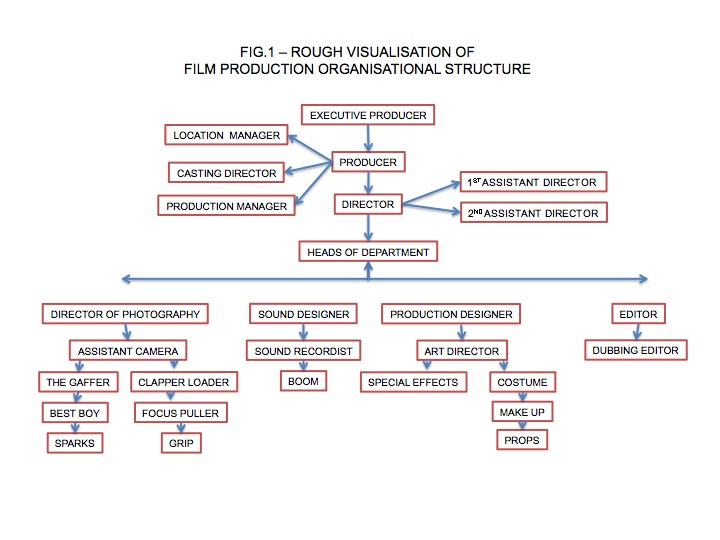
I read a very disturbing blog on the film industry a few days ago by James Fair (lecturer in Film Technology at Staffordshire University).The thing that made me sick was the site of a corporatist organizational chart. If you're anything like me, the site of these charts makes you want to puke (You may want to put your hand over it).

So here we have a film scholar (as if good filmmaking was ever a scholarly endeavor) telling us that business models are questionable in light of the artistic and creative aspects of filmmaking. Then he goes on to suggest there may be a better model out there, even though this one is working. But the current system isn't working. It never did work. The film industry is having one of its greatest depressions. Even when it was on top, 50% of all industry product never made a profit.

The problem is not that we need a better business model. The problem is that even having a conversation about a business model is absurd, which brings me to David Lynch. When I listen to him talk about the process of making a film, there is no business model or organizational structure. You may say even he has departments run by department heads, which may be true. But in a truly harmonious film production these departments operate as single entities to fulfill their respective tasks, and like our scholar mentions, none of this is ever set in stone.

The problem that 99% of the film industry continues to have is that film is not a business, nor is it purely an art. It's the business of making art, and that means that the art has to come before the business, since you can't sell your art if you don't go about making it first. This may depend on your definition of "art", which is an abstract word much like love. I think of art as stuff that moves people emotionally and even physically. That has absolutely nothing to do with making money in itself. If the moving of people can be achieved then I think the money making potential is there. You don't start out with the idea of having to make money and then come up with art that has that goal. That is not art. Nor should business have as its goal to make money without first having some higher purpose, to fill a need or fix a problem or help society.

Of course, failed American corporatism and its decades of authoritarian conservative ingrained tradition will continue to insist to its dying day that pure business models (regardless of product and with no other goal than money) are the way to go about doing any business, even art. But, like the Roman Empire, blind leading the blind (no one knows anything in Hollywood) kind of thinking is ultimate doom.

Pull out David Lynch's Inland Empire DVD. You do have one right? There, not only will you find David Lynch show you a great quinoa recipe (maybe you eat too much meat to be able to make good films that can sell on their own merit) but you'll also hear him talk about his artistic "business model", which amounts to getting one idea, then getting another idea, and eventually putting these ideas together. But if you were to talk to a good sample of great artists, you'd find that each of them have different ways of doing their art.

Even most indie filmmakers have a model where they come up with a script, and even a cast an crew, and sometimes even make the film before they go about looking for an "executive producer" (since often the only real business aspect of films is the distribution after they're made). They may or may not take notes from that producer. My understanding is that most indie producers act as patrons and seek to fund artists with no expectation of return. That is the traditional model of artistic endeavor around the world.

The one reason that any good films even exist in America, I think, is that there are indie renegades out their like David Lynch and there is also the independent spec screenwriter factor. Screenwriting can be done in a vacuum away from all the failed corporatist bullshit. So in that regard, screenwriters have the ability to be true artists, going about writing in whatever artistic way suits them (as George Lucas did far away from Hollywood). For that reason, we have some great screenplays in existence that Hollywood then gets it's greedy clammy little hands on and plugs into its organizational chart to end up with something resembling art (so long as no dogs are killed).

Another fallacy about the chart above, with the quintessential executive asshole at the top, is that there is no marketing department. Anyone and everyone knows that in the Hollywood studio system marketing is god. They only make films that project (as proven under failed corporatist business formulas) to make money. So we end up with trilogies and sequel after sequel riding on the success of previous success. We see film stories (like Inception) ripped off of other films (like The Matrix) that worked and we see a plethora of remakes that are again remade on a regular ten year schedule, just like regular old white men on Exlax.

Fuck all that.

Tuesday, July 27, 2010

Alexia Anastasio at Comic Con

I ran into Alexia's project, Adventures in Plymptoons ( a documentary on animator Bill Plympton), on IndieGoGo, where I was amused with her (and Bill's) total irreverence to anything conservatively morally straight. They have since launched a Kickstarter.com campaign to fund post production of the film. Check out Alexia's trailer:This was enough to get me to pony up $50 to help her out. We need more indie films like this and as an indie filmmaker I sincerely believe we should all help each other out. What goes around comes around. The bottom line being that if a couple thousand indie filmmakers help each other out that's enough of an audience right there to launch a film to success. There are easily a few thousand indie filmmakers out there. Something like 5000 to 6000 enter Sundance every year, not to mention thousands of other film festivals. Billions of dollars are spent every year on indie films and only a handful of them ever see the light of day, even when they're good. We have no one to blame but our collective selves.

Do you really like the crap coming out to the cineplex every week? Wouldn't you rather see indie films out there? Well do something about it. Put your money where your mouth is. Support indie filmmakers. Buy their films. Demand to see then on OpenIndie.com. Chip in a few bucks at Kickstarter or IndieGoGo. We can do this. It's a no brainer. Have you seen Ants? You know, that animation with Kevin Spacey as the bad ass grasshopper that controls hundreds of ants with his little gang, until they all realize they have him outnumbered and scare the shit out of him.

Well, we are the ants; we the indie filmmakers. The studios are the thug grasshoppers trying to control us. Why do we put up with their shit?

Alright, so anyway, I checked out Bill's booth at Comic Com, where Alexia was a guest, and interviewed her, just for kicks. Check it out.

Sunday, April 4, 2010

IMDb Video: Got Healthcare?

Protesters on various sides of the recent health care insurance reform issues, actively debated around the U.S. in the summer of 2009, are depicted as people at street rallies, protests, and town hall meetings give their views to filmmaker Jon Raymond. The film is not formally narrated but instead uses the interviews as a sort of narration and ongoing dialog that explains various aspects of the issues involved, from the question of socialism, to reports of people dying for lack of health insurance, to arrests of protesters at sit-ins.

A new 90 minute (festival cut) DVD is now available
.

Watch the trailer:

Thursday, April 9, 2009

Who Needs Hollwood? Not these guys.

There's a new movement in filmmaking. It's what you might call a "who need's Hollywood?", DIY approach. A number of new filmmakers have had some awesome success with this. The thing is there is no one way for everybody. Each filmmaker seems to find their own road. But there are some commonalities, like social networking, self-distribution, and audience interaction, and always hard work.

Arin Crumley and Susan Buice successfully produced, directed and distributed their feature film, Four Eyed Monsters, through the internet and a lot of Google time. One thing about this is that technology moves so fast, and things are ever changing, so that what worked for them is already outdated. But their independent spirit in going down their own road, even paving their way through a wilderness, was the thing we can all take away from their experience and apply to ourselves. By the way, Four Eyed monsters garnered two Independent Spirit Award nominations.

The road they took started with vlogs on YouTube. I think they planned this as part of their strategy in marketing their film. Their vlogs were about the behind the scenes "making of" stuff that you might find in typical DVD extras. But there is nothing typical about these guys. The film itself was kind of a similar docudrama of their relationship, much of it in a vlog fourth wall style. That sounds a bit repugnant on paper. But the film is really beautiful. Check out the trailer to get a feel for it.  So while the film was about their relationship's birth, life and death, as the tagline reads, the vlogs were about that too, along with the making of the film and with more reality.

The interesting this is that their "making of" experience is like none you've ever seen, or maybe never will. They forged their way to gather a YouTube and social network audience, which they translated into theatrical sales, by capturing emails and zip codes and persuading  theaters across the country to show their film during four Thursdays September in 2005, I think it was. That itself is quite an accomplishment. But it doesn't end there. in fact it still hasn't ended.

They acquired support form a number of online web film distributor ventures, including YouTube, where they were the first online feature release, and Spout.com, who paid them a dollar for everyone who they referred to Spout, amounting to $35,000. Their vlogs were so popular that they included them as a series of episodes on the DVD, along with the film and a soundtrack CD. The DVD has sold around 1500 copies through their website, mainly. Now they are talking to DVD distributors and I think they are available at Borders and maybe on a cable movie channel in the future.

This is backwards from what the conventional Hollywood big business model professes. In that model, you never release to the DVD market and certainly not the internet, until you have exploited the theatrical market. Not these guys. They offered their film for free on YouTube, along with the vlog episodes, which built interest for the DVD and generated the theatrical and DVD markets.

I've heard filmmakers worry about exposing their film like this, as a quick way to kill all chances for conventional distribution. but what Arin is saying is that conventional distribution is a pipe dream. Susan calls it the prince with the glass slipper. This is so true, and so obvious, it's amazing filmmakers haven't seen this before. We are wasting our time submitting to festival after festival, where are chances are a few hundred out of 5000 to 6000 for the big festivals. Even if we have a good film, and even if it;s picked up by a festival, the chances of finding a distributor this way are so remote. There are usually one or two film at any festival, if that, that get a distribution deal. Then what? Our films are shelved. We don't have to accept this treatment.

Like Arin and Susan we have the greatest marketing tool at our fingertips, and it's free. The internet. Lance Weller and some others have a website, WorkBookProject.com, where these kinds of things are discussed openly. You'd be surprised at how many filmmakers are finding audiences this way.

Here are some websites to check out:

FourEyedMonsters.com
WorkBookProject.com
Spout.com
YouTube Screening Room
Blip.tv
IndieGoGo
BraveNewTheaters.com

At these sites you'll find a lot more links.

Check out my own venture at OutInTheStreetFilms.com, and my film project, Stop War.

Blog Archive

Popular Posts

Mistress City

Cinephilia and Beyond

Keyframe - Explore the world of film.